
Rodent Health Monitoring
What is the Rodent Health Monitoring Initiative?
Research facilities that house rodents have traditionally used soiled bedding sentinel health-monitoring programs to detect rodent pathogens within research colonies that could affect research results. Unfortunately soiled bedding sentinels (SBS) have limitations in terms of accuracy, require the use of live animals, and can be costly and time consuming. The rodent health monitoring initiative was created to highlight the pitfalls of soiled bedding sentinels while encouraging the use of Environmental Health Monitoring (EHM).
What is Environmental Health monitoring (EHM)?
Environmental health monitoring is a fantastic alternative to sentinel animals that has many advantages, and overcomes some of the limitations of soiled bedding sentinels (SBS). EHM involves the surveillance of rodent colonies for pathogens without the use of sentinel animals. These methods replace live animal sentinels through sampling and swabbing techniques from dust, debris, and/or pooled soiled bedding. Environmental samples can be analyzed through the use of very sensitive and specific molecular tests (e.g. PCR) to determine colony health. Environmental health monitoring is now recognized for its efficacy in detecting multiple rodent pathogens when used as an adjunct or complete replacement to SBS (see the
publications tab for more details).

3Rs: Replace Sentinel Mice

Improve Pathogen Detection
(Earlier & More Accurately)

Reduce Labor & Cost

One Welfare: Reduce Emotional Fatigue
Many institutions have replaced their sentinels with EHM.
Many institutions, from both Canada and the United States, have replaced their soiled bedding sentinel (SBS) health monitoring programs with Environmental Health Monitoring (EHM) programs. The number of institutions worldwide who now use EHM solely for rodent health monitoring is continually growing!
Over 40 US institutions have shared that they have replaced soiled bedding sentinels with EHM including: Amgen, Allen Institute, Benaroya Research Institute, Calico Labs, Chapman University, Cornell University, Emory University, Emory National Primate Research Center, EMD Serono, FDA White Oak Animal Program, GSK, Harvard University, La Jolla Institute for Immunology, Leland Stanford Jr. University, Midwestern University, Meadowhawk Biolabs, Medical College of Wisconsin, Millepore Sigma, Northwestern University, Oregon Health & Science University, Par Health, Penn State University College of Medicine, Pennington Biomedical Research Center, Pfizer Comparative Medicine sites (Kendall Square, La Jolla, Pearl River, Groton), Purdue University, Roskamp Institute, Seagen, Southern Illinois University, University of Alabama at Birmingham, University of Arizona, University of California – Los Angeles (UCLA), University of Chicago, University of Colorado Anschutz Medical Campus, University of Florida, University of Illinois – Chicago, University of Kansas, University of Nebraska Medical Center, University of Rochester, University of Southern California, University of Texas at Austin, UT Southwestern Medical Center, University of Utah, University of Washington, and Vanderbilt University Medical Center.



Canadian institutions include: The Centre for Phenogenomics, The Research Institute of the McGill University Health Centre, Comparative Medicine Animal Resources Centre at McGill, Montreal Clinical Research Institute, University of Guelph, University of Saskatchewan, and University of Waterloo.



Institutions in other parts of the world include: Technion Israel
EHM looks like it will work for colony health, but what about quarantine?
Many institutions have replaced the use of soiled bedding sentinels with EHM for routine health monitoring, but what about quarantine? In quarantine, the historic use of contact sentinels (animals that would be placed in direct contact with your incoming animals) and soiled bedding sentinels (SBS) has been replaced with direct colony sampling (DCS). There is some growing literature that environmental health monitoring in the form of Sentinel Free Soiled Bedding (SFSB) can replace the need for direct colony sampling (DCS), thus potentially reducing animal distress and time associated with quarantine sampling of larger shipments.
How do I implement environmental health monitoring?
Making the switch to EHM can be quite easy! There is enough literature available now indicating the efficacy of EHM as compared to traditional SBS (see our
presentations and
publications tabs for details), however some institutions may choose to conduct a small pilot program to gain institutional buy-in for this method of health monitoring before switching solely to EHM. Specific steps for switching can be found on the
how to switch tab. In general, switching can be broken down into three main steps: Determining your caging type, selecting your sampling type, and creating facility SOPs. If you need or want help in the switching process, the 3Rs Collaborative offers a mentorship program for interested individuals. Please refer to our
mentorship program tab for more details, or to get signed up with the mentorship program.
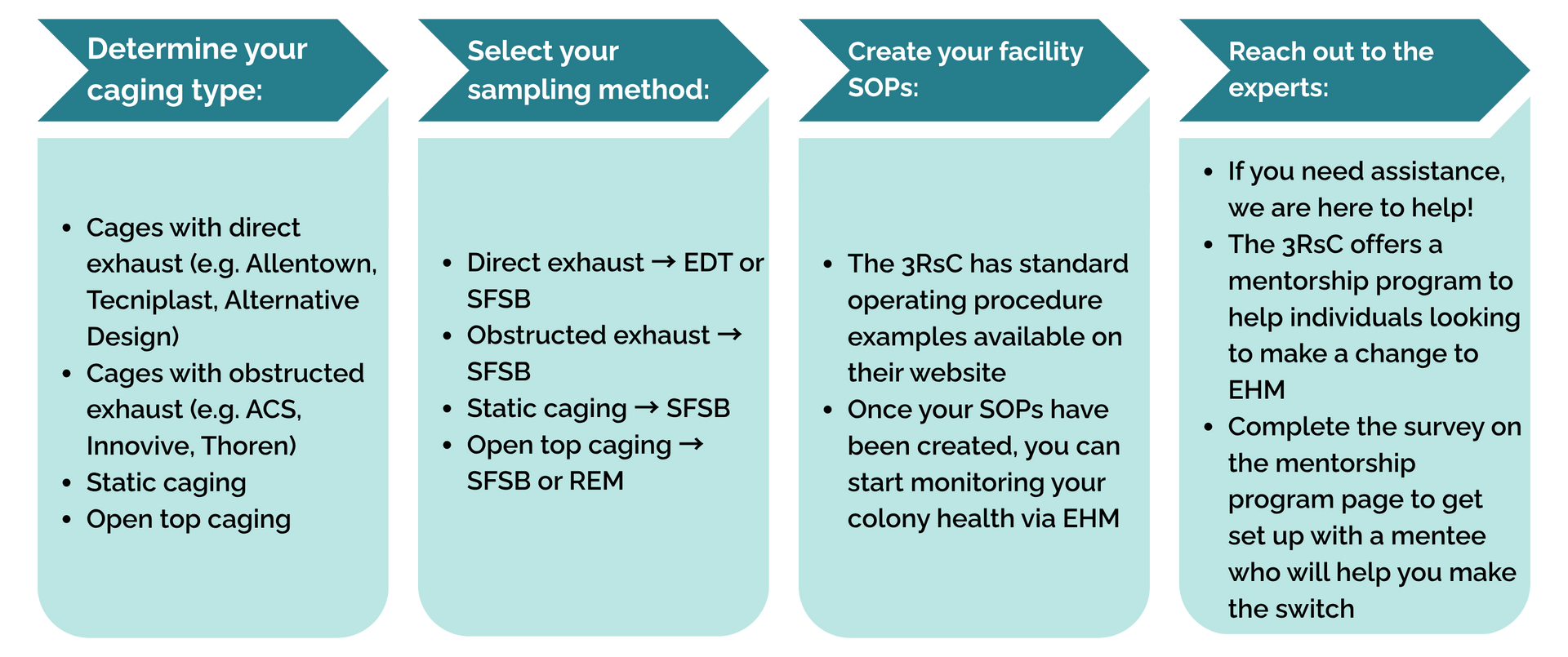
The first step to implementing EHM is to determine your type of caging. Cages can be divided into three categories: Those with direct exhaust to a centralized plenum (e.g. Allentown, Tecniplast, or Alternative Design), those with obstructed or filtered exhaust at the cage level (e.g. ACS, Innovive, or Thoren), and those with no exhaust (e.g. static cages or open top cages). Many institutions have a mixture of cages or caging types. For these institutions, a variety of environmental health monitoring methods may be used depending on the housing room/rack/location.
Once you have determined your caging type(s), the second step is to determine your preferred sampling method. Multiple EHM sampling methods can be used, and the best method(s) are dictated by the type of caging that you have. Ultimately, an environmental sample is collected and analyzed for rodent pathogens by PCR testing.
- Exhaust Dust Testing (EDT): For IVC racks that exhaust at the rack level (i.e., Allentown Inc., Alternative Design, TecniplastTM). Note that there are commercialized systems for testing using this method (e.g., EAD, EDx, or EnviroRax depending on your diagnostic lab.)
- Sentinel-Free Soiled Bedding (SFSB). For ALL caging types including static cages or IVC racks that exhaust at the cage level (i.e., Animal Care Systems, Inc., Thoren, Inc., Innovive, Inc., Lab Products, LLC): (Note that there are commercialized systems for testing using this method (e.g. PathogenBinder, Replace, BioDisk™/BioBroom™)
- Direct Colony Sampling (DCS): For all cages and rack types, though typically used in quarantine, smaller colonies, or for further diagnostics.
- Room & Equipment Monitoring (REM): For all cages and rack types, but most helpful for open-top cages or rooms containing specialized equipment.
When your preferred sampling method(s) have been determined, it is beneficial to create institutional SOPs to aid in the transition. Below we briefly describe each environmental health monitoring method.
Exhaust Dust Testing (EDT)
The exact method of exhaust dust testing depends on your specific caging type.
Exhaust Dust Testing with Allentown Caging
Allentown has developed two different sample capture units to collect particles moving from the cage to the exhaust filtration system to perform environmental health monitoring that can be integrated in Allentown IVC plenum chamber. The original SentinelTM system works with all available Allentown air handling options including rack mounted or trolley mounted blowers as well as facility exhaust. The newer Sentinel2 device mounts to the top of the exhaust plenum or on the blower inlet allowing users to access the removable media without entering the exhaust plenum itself. In both situations, the collection media stays for a specific period of time (typically 3 months) and then is submitted to a diagnostic laboratory for PCR analysis. Please see our universal SOP for more details on using this system.
Note: Based on the external placement, the Sentinel2 design may be modifiable for use with other direct exhaust systems that do not have their own devices, such as Alternative Design racks.
Exhaust Dust Testing with Tecniplast Caging
Tecniplast has developed the Interceptor system to collect particles moving from the cage to the exhaust filtration system to perform environmental health monitoring that can be integrated with Tecniplast caging. The Interceptor works with the Tecniplast air handling units via a stainless-steel frame designed to hold an irradiated cardboard folder containing a sliding filter. Some facilities may have Tecniplast IVCs controlled by a centralized ventilation system. In these situations, a plenum attachment (instead of the stainless-steel frame) is required to house the cardboard folder containing the sliding filter. In both situations, the Interceptor filter is exposed to exhaust air for a specific period of time (typically 3 months) and then submitted to a diagnostic laboratory for PCR analysis.
Please see our universal SOP for more details on using this system.
Sentinel-Free Soiled Bedding (SFSB)
Exhaust dust testing is not an option for static cages, open top cages, or for racks that filter at the cage level. In these cases, sentinel-free soiled bedding testing can be used. For continuity, some institutions also prefer to use only this type of sampling across an entire organization.
In short, soiled bedding from colony animals can be added to a dedicated animal-free cage (where sentinel animals would usually be placed) or dedicated sampling bin (e.g., PathogenBinderTM) at each cage change. After a specific period of time (typically 3 months), some type of media (swabs or filter, e.g., ReplaceTM, BioDisk™/BioBroom™) is placed in that cage and shaken or stirred. This media is then submitted to your diagnostic laboratory of choice for PCR analysis. Please see our universal SOP for more details on using this system. Sensitivity of this method may be increased by also submitting pooled fecal samples in conjunction with the choice of media.
Despite this method still being reliant on soiled bedding transfer and potentially regular agitation, it is still an effective replacement for the use of sentinel rodents. These methods are similar to historical husbandry operations involving soiled bedding sentinel mice with little alteration to staff schedule, however staff time is still gained due to lack of sentinel mouse ordering, associated sentinel mouse care, and more complicated sample coordination/collection (e.g. animal sample collection).
Direct Colony Sampling (DCS)
Direct Colony Sampling can also be used to routinely monitor colony health with all cage and rack designs, however, this method is NOT a historic method of sampling and therefore should be used under the direction of a diagnostic laboratory or a veterinarian well-versed in rodent colony health surveillance. Direct colony sampling involves non-invasive or minimally invasive collection of samples taken directly from research animals instead of using soiled bedding sentinels. These samples can include feces, pelt swabs, and/or oral swabs, which are analyzed by PCR. This method is commonly used for rodent quarantine health monitoring of newly arrived rodents to a facility, but is not often used as the primary health monitoring strategy due to the larger number of animals that would need to be sampled to provide colony health status. It can be used for confirmatory testing after a positive test by a different environmental health monitoring method. Finally, DCS is also often used if sick animal(s) are found, and is particularly useful in detecting emerging pathogens. Sensitivity of DCS may be increased by also microsampling blood from colony animals. Please see our universal SOP for more details on using this system.
Room & Equipment Monitoring (REM)
Health monitoring methods may be complemented with the use of Room & Equipment Monitoring. It should be used under the direction of a diagnostic laboratory or a veterinarian well-versed in rodent colony health surveillance. This involves direct sampling and testing of the laboratory animal facility environment, including walls, floors, room filters, and equipment such as dump stations, biosafety cabinets, or behavioral testing equipment that has rodent contact, or with open-top cages. The type of structures and equipment, number, and frequency of testing should be considered based on the risks of infection by various agents, their route of exposure and transmission, other surveillance methods used, and facility-specific characteristics such as type of housing. Please see our universal SOP for more details on using this system.