
Time and other concerns about using refined handling
There are a number of common concerns about implementing refined handling that individuals and institutions mention. This page serves to address some of these common concerns:
time,
biosecurity.
welfare concerns and
buy in. This page also aims to provide education on misconceptions and suggest solutions to real barriers.
Time to cage change and/or handle
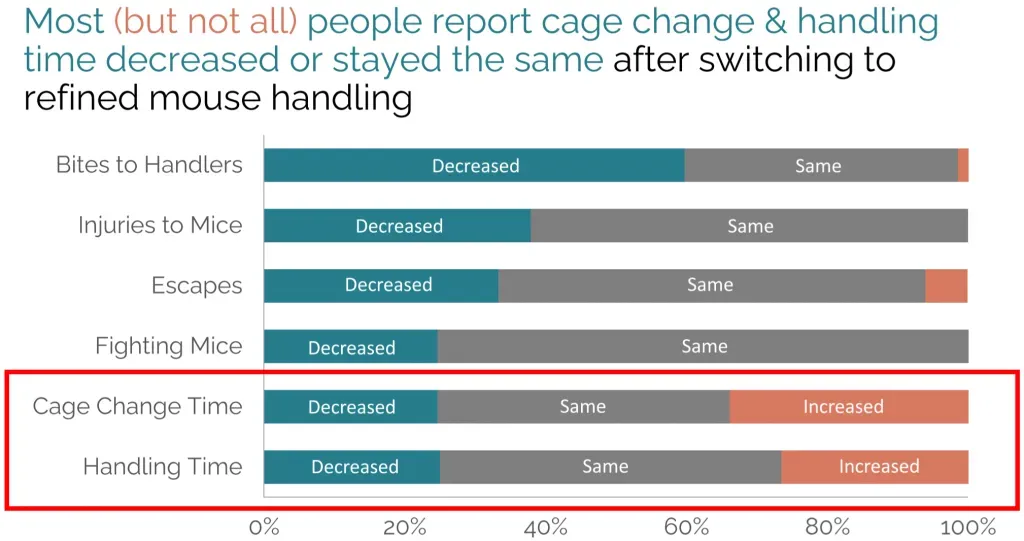
Preliminary data from the second round of our survey on refined handling use allowed us to ask individuals about common concerns to using refined handling and how these factors changed after implementing refined handling.
We found that the majority of respondents (>60%) report that cage change and handling time decreased, or stayed the same, after switching to refined handling.
It is important to recognize that people may be slower at first when learning a new technique. However, once staff and mice are adequately trained using refined methods, husbandry tasks and experimental procedures typically do not take any longer than with tail handling. For cup handling, typically some habituation for the mice is required, so it may take longer initially.
Keeping tunnels in the home cage may help with handling speed. In one study where tunnels were placed in the home cages two weeks earlier, tunnel handling mice for cage changes was found to be faster than tail handling with forceps on both the first and second cage changes. No training of the mice was needed (Hull et al. 2022).
In an additional study, researchers found that using cup handling took less time for cage change than using forceps (Doerning et al. 2019).
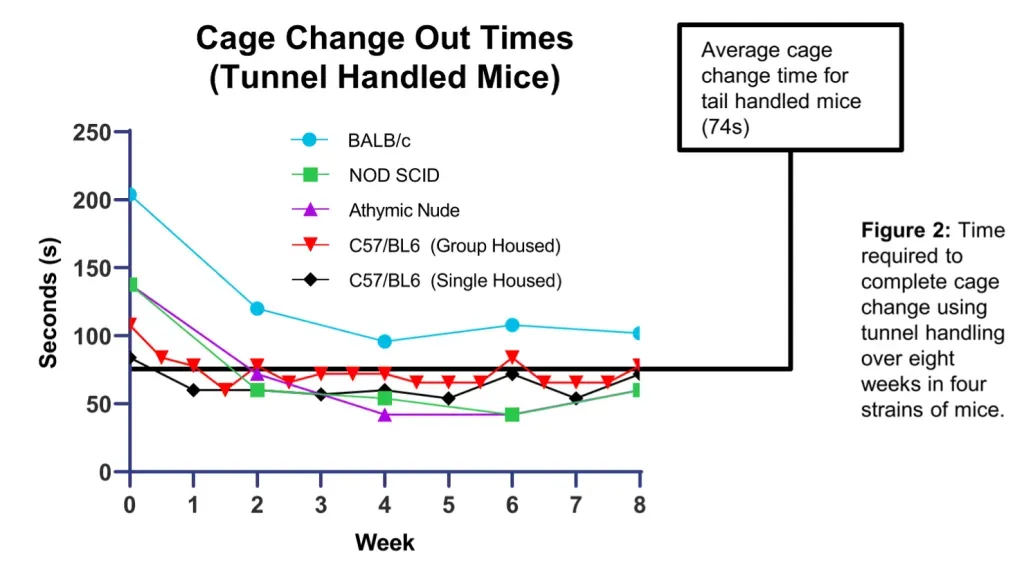
A study by Arnott et al. (2023) at AMGEN (full poster linked here), found that tunnel handling took less time than tail handling for a number of mouse strains.
The only outlier were Balb/c mice. This is a great example of how different strains may react differently to humans or handling techniques. Some strains may be slower to habituate to tunnel or cup handling - but if this reflects underlying fear or anxiety, these mice may benefit even more from a bit of patience in handling interactions.
Biosecurity
Refined handling can also be compatible with high biosecurity laboratories and facilities. The primary approach that is recommended is sanitizing gloves between cages, in the same way that one would sanitize forceps. Tips listed below are based on the successful implementation of this technique in current facilities:
- Make use of what is already available to you: cleaning spray bottles or automatic hand sanitizer dispensers located in the cage change area for efficiently and effectively sanitizing hands, gloves, oversleeves etc…
- Use dip boxes to sanitize hands in between cages, similar to dip boxes used for forceps
- When selecting the choice of sanitizer, choose something that is both suitable for directly handling animals, and compatible with PPE material
* In Biohazard colonies where hands are not allowed to touch the animals, a tunnel can be used instead and kept in the homecage (see below) or a sterile supply can be kept in the colony room.
Check out our refined handling course which contains more information about using refined handling while maintaining biosecurity, by clicking the link
here.
Injuries to mice or handlers
Refined handling was actually first created and implemented to handle very jumpy wild mice (see Gouveia & Hurst 2010), and thus may be most beneficial for these animals, as it is shown to help them become easier to handle, over time.
Mice may bite in response to acute fear or stress associated with handling. Refined handling methods might decrease bite risks and improve ease of handling, given that they decrease anxiety, stress, and depression-like states. Mice handled using refined methods are also significantly more likely to voluntarily interact with a handler.
Also as seen in the results from our survey (pictured above):
- All respondents stated that, after switching to refined handling methods, injuries to mice and fighting either decreased or stayed the same.
- Nearly all respondents also state that mouse escapes and bites to handlers are decreased or stay the same.
Buy-in from managers or colleagues
See our
Institutional Change page for more information on steps to improving buy-in.
Need more information?
Check out the other pages of this Refined Handling Hub for more detailed information on the topics related to refined mouse handling. In addition, check out our recent publication on a survey on refined handling for more information on barriers and misconceptions:
https://doi.org/10.1371/journal.pone.0288010